•
•
•
•
•
•
•

The Personal Agent Protocol aims to let a customer’s AI assistant interact with businesses under clear identity, sign-in and permission rules. Here is what it does—and what it does not yet guarantee.
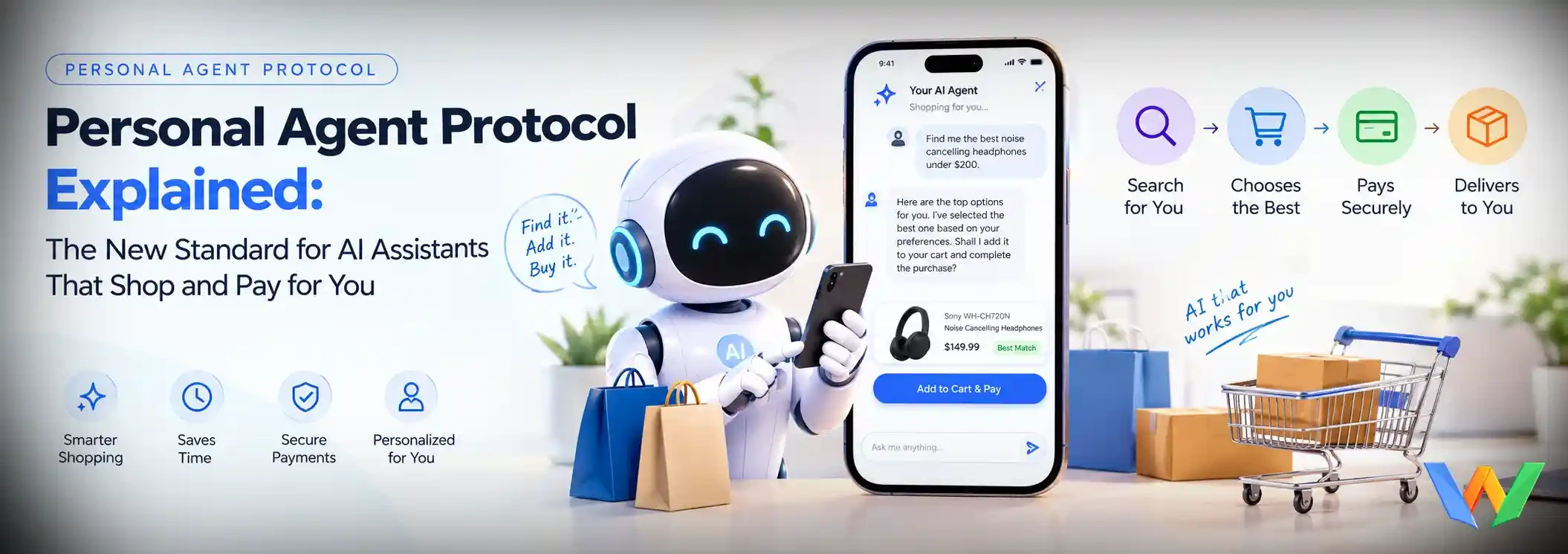
The Personal Agent Protocol (PAP) is an emerging standard intended to help a person’s AI assistant interact with a business on that person’s behalf. Rather than treating every automated visitor as an unknown bot—or giving an agent unrestricted access to a customer account—the idea is to provide a clearer way for businesses to identify an agent, authenticate the customer and control the actions the agent is permitted to take.
Sierra and Meta announced the initiative in October 2026 with industry partners. The protocol is still an evolving technology, so businesses should check its official documentation for the latest specification and implementation status.
An assistant may help a user compare products, check availability, review a return policy, manage a booking or complete another online task. Today, a business website may not know whether a request comes from a person, an authorised assistant or an abusive automated script.
A shared protocol could help make that interaction more predictable. It can establish how an agent discovers a participating business, how the customer signs in, and which actions the business allows.
The broad idea can be understood in four stages:
The exact technical behaviour depends on the published specification and each business’s implementation. A protocol does not automatically make every website compatible.
Permission design is central to the concept. A business might expose read-only tasks—such as checking opening hours, product details or order status—separately from actions that change something, such as modifying an order or cancelling a booking.
For higher-impact actions, businesses should consider explicit confirmation, clear spending or action limits, short-lived credentials, audit logs and an easy way to revoke access. These are sound security practices, not a guarantee that every implementation will provide every safeguard by default.
Do not assume that the protocol itself currently provides a complete payment system. The protocol’s focus is how personal agents connect to businesses, authenticate and act within permissions. Payment capabilities have been discussed as a possible extension, but readers should verify the latest official specification before treating payment support as available.
Several related initiatives address different parts of agentic commerce. For example, Google’s Agent Payments Protocol (AP2) focuses on authorised agent-led payments, while Google’s Universal Commerce Protocol (UCP) addresses interactions across the commerce journey. These are distinct projects and should not be described as interchangeable with PAP.
| Technology | Main role |
|---|---|
| Personal Agent Protocol (PAP) | Helps a person’s agent interact with a business under defined identity and permission rules |
| OAuth | A widely used framework for delegated authorisation |
| Model Context Protocol (MCP) | A standard way for AI applications to connect to tools and data sources |
| OpenAPI | Describes HTTP APIs so software can understand how to call them |
| Agent Payments Protocol (AP2) | Focuses on authorisation and trust for agent-led payments |
| Universal Commerce Protocol (UCP) | Supports standardised interactions across commerce workflows |
These technologies may complement one another; none should be assumed to replace all the others.
Businesses do not need to grant broad access to every AI agent. A sensible preparation plan is to:
Retailers should also keep product data, inventory, prices, delivery terms and return policies accurate. An agent cannot reliably represent a business if the underlying information is wrong.
An authorised agent can still make mistakes or misunderstand a request. Businesses should guard against prompt injection, stolen or over-scoped credentials, unauthorised changes, excessive data collection and automated abuse. Customers should be able to understand what they have authorised and withdraw that permission.
A protocol can create a shared framework, but security still depends on implementation, operational controls and the choices made by users and businesses.
No. It is a protocol intended to standardise interactions between personal agents and businesses.
No. A business needs to support the relevant protocol or provide compatible interfaces.
No. These technologies serve different roles and may be used together.
That is a core goal of the protocol: businesses define supported capabilities and access, while users grant permissions through the supported flow. Actual controls depend on implementation.
Do not assume so. Check the official documentation for the current draft, compatibility, security guidance and implementation status before deploying it.
The Personal Agent Protocol addresses an important problem as AI assistants move from answering questions to carrying out tasks: how can a business recognise an agent and safely control what it may do for a customer? Its value will depend on clear permissions, practical implementations and strong privacy protections. Because the standard is evolving, businesses should rely on its official documentation rather than assume that every announced feature—including payments—is already available.
This article was authored and reviewed by Wipidia's technical editorial desk in Jalandhar, Punjab. Every code snippet, algorithm breakdown, and strategic framework is independently tested against live production standards before publication.