•
•
•
•
•
•
•

A fact-checked guide to Tesla’s 2026 autonomous taxi plans, Roadster demonstration, humanoid robots, Semi truck and next-generation AI chip—with announced targets separated from delivered products.
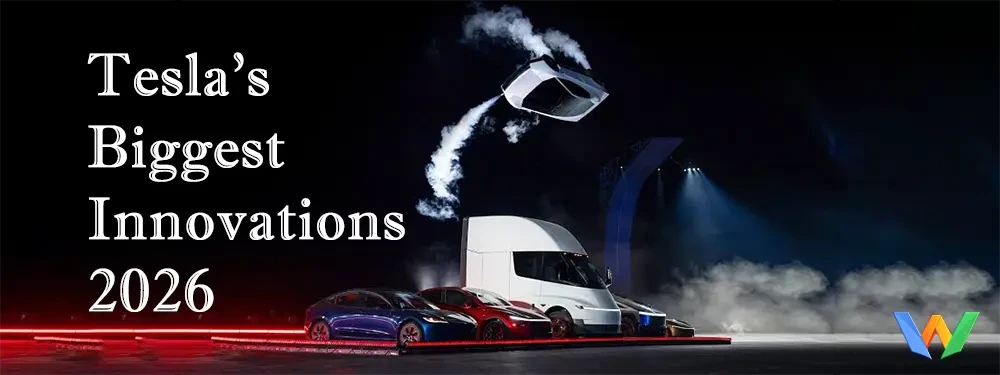
Tesla’s 2026 product story reaches beyond electric cars into autonomous ride-hailing, humanoid robots and in-house AI computing. But its announcements include a mixture of demonstrated technology, limited deployments, manufacturing goals and future plans. Those categories should not be treated as equivalent.
This guide reviews the Cybercab, Roadster, Optimus, Semi and AI5 processor, distinguishing what has been announced from what is already operating at scale.
| Project | What is known | Important caveat |
|---|---|---|
| Cybercab | Two-seat autonomous vehicle designed without conventional driver controls | Public deployment and production scale depend on manufacturing and regulatory requirements |
| Roadster | Tesla demonstrated a new Roadster concept with a dramatic stunt on October 15, 2026 | A demonstration does not establish that it is a practical, road-legal flying car |
| Optimus | Tesla is developing humanoid robots for repetitive and potentially hazardous tasks | Announced factory use or sales targets are not proof of broad commercial deployment |
| Tesla Semi | Heavy-duty battery-electric truck programme | Production capacity and actual output are different measures |
| AI5 | Tesla said its next-generation AI processor design reached tape-out in April 2026 | Tape-out is a design milestone, not completed mass production |
The Cybercab is Tesla’s purpose-built two-seat autonomous vehicle. It is designed without a steering wheel or pedals, reflecting Tesla’s plan to build a vehicle around robotaxi operations rather than ordinary human driving.
Tesla has discussed public availability and expansion of its robotaxi service, but production volume, regulatory compliance and the geographic scope of driverless operation remain important constraints. A limited service in one location should not be confused with a fully scaled national network.
In July 2026, reporting on Tesla’s second-quarter shareholder letter said the company had moved away from earlier plans to reach volume production of Cybercab in 2026. In October, Tesla executives were still describing plans to sell the vehicle to the public by the end of the year. These are evolving targets, not a guarantee of delivery.
Tesla unveiled a new Roadster demonstration on October 15, 2026. The presentation included dramatic manoeuvres involving jets or thrusters and a vehicle briefly moving through the air. That spectacle attracted attention, but the phrase “flying car” requires care.
A short stunt or demonstration does not establish sustained, controlled flight, practical passenger transport, certification or road legality. The new Roadster should therefore be described as a sports car concept with a claimed propulsion demonstration—not as an available flying vehicle.
Tesla has not established through this demonstration that customers can use the Roadster as an aircraft. Performance figures, production timing, price and final specifications should be treated as company claims or targets until verified in production vehicles.
Optimus is Tesla’s humanoid robotics programme. The company has described potential uses such as repetitive factory work and tasks that may be difficult or hazardous for people.
The major engineering challenges include reliable manipulation, safe movement around people, battery life, cost, maintenance and the ability to handle unexpected situations outside controlled demonstrations. A robot performing a task in a staged video does not prove it can complete that task reliably across a full shift or in a different workplace.
Tesla has discussed future manufacturing and sales targets. Readers should look for evidence of sustained deployment, independent evaluation and clear performance measures before concluding that humanoid robots are already a large commercial business.
The Tesla Semi is a battery-electric heavy truck intended to reduce tailpipe emissions and operating costs in freight transport. Its real-world value depends on purchase price, payload, charging access, energy use, maintenance and the routes a fleet operates.
Tesla has described a dedicated manufacturing programme in Nevada. However, factory capacity is not the same as trucks produced or delivered. Fleet operators should compare independently measured energy consumption, charging time, uptime and total cost of ownership with diesel and other electric trucks.
Tesla said in April 2026 that it had completed the final design of its next-generation AI5 inference processor. In semiconductor development, “tape-out” means the design is sent for fabrication; it does not mean the chip has completed validation or entered high-volume production.
The chip is intended to support demanding AI workloads associated with driver-assistance systems and robotics. Before it can be judged in practice, it must be manufactured, tested, validated and integrated into products. Tesla’s timing for high-volume production remains a forward-looking target.
Tesla’s energy business includes battery storage products for homes, businesses and the electricity grid. Grid-scale storage can help manage variable renewable generation and periods of high electricity demand. The commercial picture depends on deployment volumes, project economics, battery supply and competition.
For the most accurate quarterly numbers, consult Tesla’s latest shareholder deck and regulatory filings rather than relying on figures repeated by secondary articles.
Tesla is attempting to build businesses around transport, autonomy, robotics and computing. If the products become reliable and affordable at scale, they could influence how people travel, how factories operate and how companies deploy AI.
The main questions are practical: when products will be delivered, how well they perform outside demonstrations, whether regulators approve the proposed uses, and whether the economics work for customers. Announcements alone cannot answer those questions.
The October 2026 demonstration showed a dramatic stunt, but it does not establish that the Roadster is a certified aircraft or capable of practical sustained flight.
No. Robotaxi operations and vehicle availability depend on location, production and regulatory requirements.
Future targets and demonstrations should not be confused with independently verified large-scale commercial use.
It means the chip design reached a stage where it was sent for fabrication. Manufacturing, testing and volume production still follow.
Start with Tesla’s investor relations website and official vehicle information, then compare major claims with independent reporting.
Tesla’s 2026 innovations are best understood as a combination of genuine engineering milestones and ambitious future plans. Cybercab, Optimus, Semi and AI5 each face different technical and commercial hurdles, while the Roadster demonstration should not be mistaken for proof of a practical flying car. Tracking verified deliveries, regulatory approvals and real-world performance will provide a more useful picture than headlines alone.
This article was authored and reviewed by Wipidia's technical editorial desk in Jalandhar, Punjab. Every code snippet, algorithm breakdown, and strategic framework is independently tested against live production standards before publication.