•
•
•
•
•
•
•

Meaning, history, how it works, headset types, buying checklist, uses and safety, explained simply
Last reviewed: October 26, 2026
Virtual reality (VR) is technology that places you inside a computer-generated 3D environment. You wear a headset that fills your vision and tracks your head and hand movement, so the digital world responds as if you were physically there.
Instead of looking at a flat screen, a VR headset surrounds you with a simulated space. The key idea is presence: your brain accepts the simulated space as real enough to react to it, even though you know it is not.
VR is one part of XR (extended reality), which also includes augmented reality (AR) and mixed reality (MR).
| Year | Milestone |
|---|---|
| 1950s | Early immersive machines, such as the Sensorama, aim to engage multiple senses |
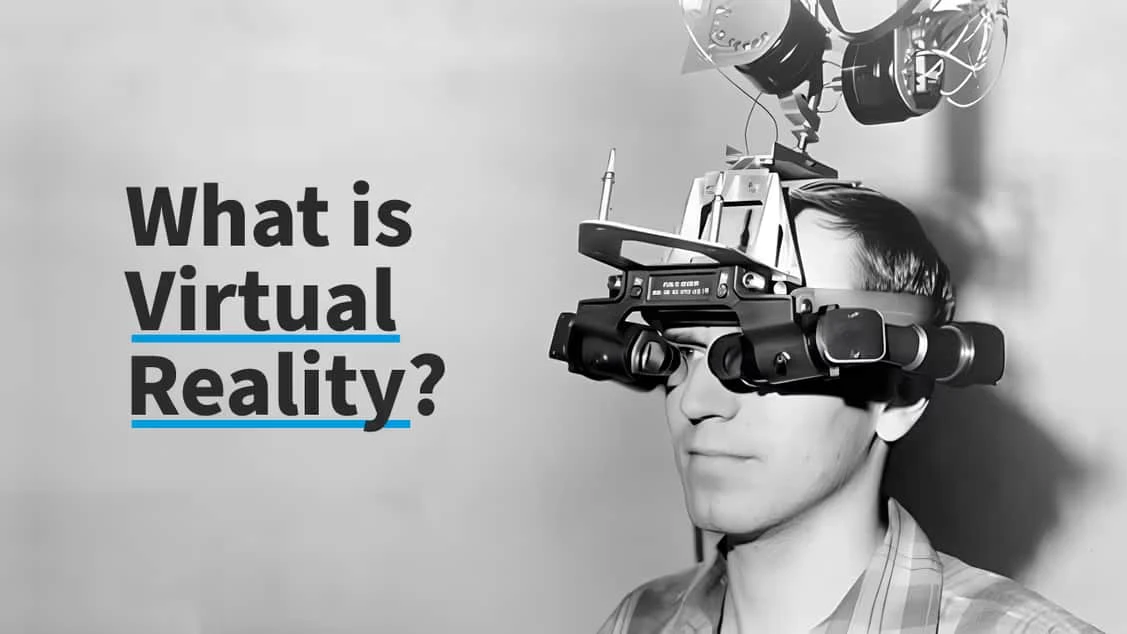
| 1968 | Ivan Sutherland builds an early head-mounted 3D display, nicknamed the "Sword of Damocles" |
| 2012 | The Oculus Rift raises funds on Kickstarter, reviving consumer interest |
| 2014 | Facebook acquires Oculus |
| 2016 | Consumer headsets such as the Oculus Rift and HTC Vive reach the market |
| Today | Standalone headsets with built-in processors make VR wireless and more accessible |
VR combines hardware, sensors and software to convince your senses. Six building blocks do most of the work.
A headset shows each eye a slightly different image, just as your eyes see slightly different views in real life. Your brain merges them into a sense of depth.
Lenses between your eyes and the screens bend light so the image fills your field of view and appears at a comfortable focal distance.
Gyroscopes, accelerometers and cameras track where your head and hands are.
| Tracking type | How it works | Example use |
|---|---|---|
| 3DoF | Tracks rotation only (look around) | Simple 360° video |
| 6DoF | Tracks rotation and position (walk, lean, duck) | Modern games and training |
| Inside-out | Cameras on the headset watch the room | Standalone headsets |
| Outside-in | External sensors track the headset | High-precision setups |
The image must update within a tiny fraction of a second after you move. Delays create a mismatch between what your eyes see and what your inner ear feels, which can lead to motion sickness.
Handheld controllers or camera-based hand tracking let you interact. Spatial audio makes sounds seem to come from specific directions.
Game engines draw two views of the scene continuously. Some headsets use a connected PC, while standalone headsets have built-in processors.
Many headsets and apps now share a common developer standard. OpenXR, from the Khronos Group, is a royalty-free open standard that gives developers one way to reach many VR and AR devices. That is why the same app can often run on headsets from different makers.
| Type | Strengths | Trade-offs |
|---|---|---|
| Standalone headsets | All-in-one and wireless | Less graphics power than a gaming PC |
| PC-connected headsets | Highest graphics quality | Needs a capable computer and cables or a wireless link |
| Console-based VR | Simple setup for gamers | Limited to the console's games |
| Mobile or cardboard viewers | Very low cost | Limited tracking and quality |
| Technology | Meaning | Example |
|---|---|---|
| VR | Fully virtual environment | A flight simulator |
| AR | Digital content overlaid on the real world | A phone app that places furniture in your room |
| MR | Digital objects that interact with the real world | A virtual ball that bounces off your real table |
| Feature | Why it matters |
|---|---|
| Display resolution | Higher resolution gives a sharper image and less visible pixel grid |
| Refresh rate | Higher rates feel smoother and can reduce discomfort |
| Field of view | A wider view feels more immersive |
| Tracking (3DoF or 6DoF) | 6DoF lets you move naturally in the space |
| Standalone or PC-connected | Decides portability, graphics quality and total cost |
| Comfort and weight | Matters for longer sessions |
| Battery life (standalone) | Limits how long you can play |
| Game and app library | Determines what you can actually do |
| Prescription lens support | Important if you wear glasses |
In 2021, the US Food and Drug Administration authorized EaseVRx, a prescription VR system that uses cognitive behavioural therapy to help adults with chronic lower back pain. The decision rested on a randomized, double-blinded study of 179 participants.
It shows that VR is moving from entertainment into regulated medical use. It also shows why claims about health benefits should be checked against trial evidence rather than marketing.
If you are thinking of trying VR in India, these practical points matter:
Prices and availability change often, so check current listings from official sellers before buying.
Benefits: immersive learning, safe practice of risky tasks, remote presence.
Limitations: cost, motion sickness for some users, headset weight, limited content in some fields, and privacy concerns around sensor data such as head, hand and room tracking.
| Myth | Reality |
|---|---|
| VR is only for gaming | It is also used in training, healthcare, design and education |
| VR always causes motion sickness | Many people adapt, and good comfort settings and content choices help a great deal |
| VR and the metaverse are the same | VR is a technology, while "metaverse" usually refers to shared virtual worlds |
| You need a powerful PC | Standalone headsets have their own processors |
| Term | Meaning |
|---|---|
| Presence | The feeling of really being in the virtual space |
| 6DoF | Six degrees of freedom: tracks both rotation and position |
| Latency | The delay between your movement and the image update |
| Refresh rate | How many times per second the screen redraws |
| Field of view | How much of the scene you can see at once |
| XR | Umbrella term for VR, AR and MR |
| OpenXR | An open standard for building VR and AR apps across devices |
What is VR in simple words?
A headset-based way to step into a digital world.
How does virtual reality work?
Two slightly different images, motion tracking and fast rendering create a convincing 3D space.
What technology does VR use?
Displays, lenses, motion sensors, controllers, spatial audio and real-time 3D software.
Is VR safe?
Generally yes for short sessions, but it is not right for everyone. Manufacturers' health warnings advise breaks, supervision for children and caution for people with certain medical conditions or a history of motion sickness. Meta, for example, states a minimum account age of 10 for Meta Quest headsets, with requirements that may vary by country. Read your headset's official safety guide and talk to a doctor if you have concerns.
Is VR the same as the metaverse?
No. VR is a technology for experiencing 3D spaces. "Metaverse" usually refers to shared virtual worlds that people may visit using VR or other devices.
Do I need a gaming PC for VR?
Not always. Standalone headsets have their own processors, while PC-connected headsets use your computer for higher graphics quality.
This article was authored and reviewed by Wipidia's technical editorial desk in Jalandhar, Punjab. Every code snippet, algorithm breakdown, and strategic framework is independently tested against live production standards before publication.