•
•
•
•
•
•
•

Earthquakes occur when stress is released along faults. Learn how seismic waves work, how magnitude differs from intensity, and why the deadliest quake is not always the strongest.
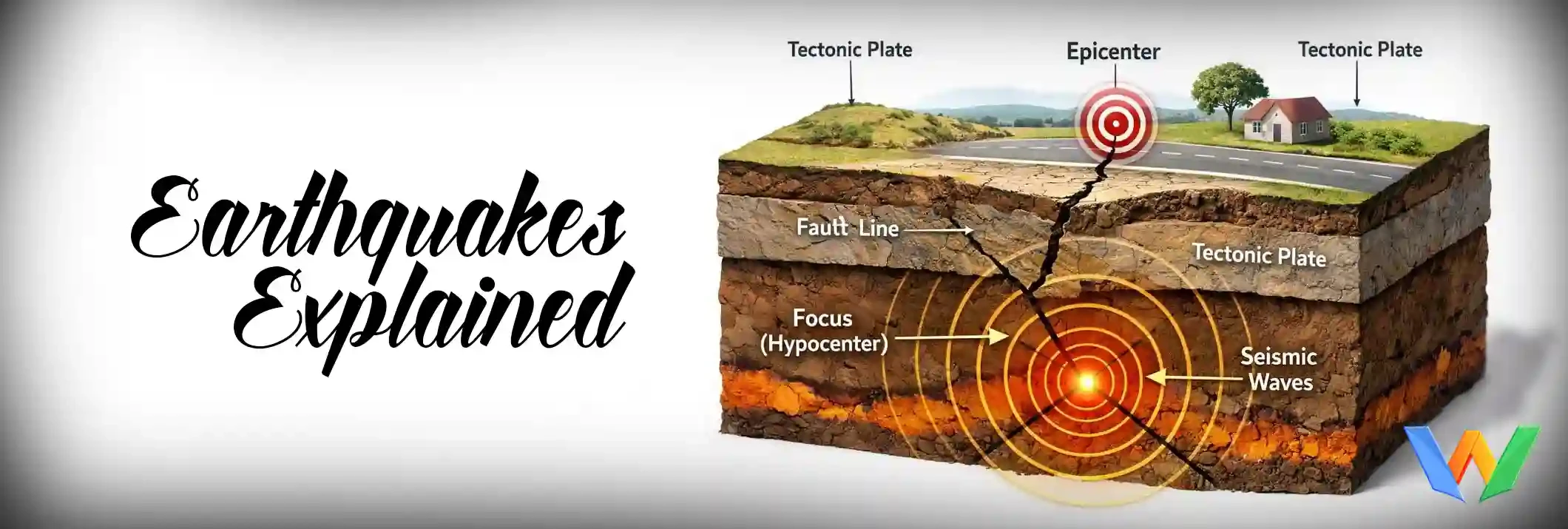
An earthquake is ground shaking caused by a sudden release of energy in Earth's crust or upper mantle. Many damaging earthquakes occur when rocks slip along a fault after stress builds up through tectonic movement. The energy travels as seismic waves.
The shaking at a particular place depends on magnitude, depth, distance, local geology, building design and duration.
| Term | Meaning |
|---|---|
| Focus or hypocentre | Underground point where rupture begins |
| Epicentre | Surface point directly above the focus |
| Fault | Fracture or zone where rocks move relative to one another |
| Magnitude | Measure of an earthquake's size |
| Intensity | Shaking and effects at a particular place |
| Aftershock | A subsequent earthquake in the affected region |
Tectonic plates move slowly. Friction can lock parts of a fault while stress accumulates; when rocks suddenly slip, energy is released. Earthquakes commonly occur at convergent, divergent and transform plate boundaries, but also occur within plates and in association with volcanic activity. Some human activities can trigger earthquakes by changing underground pressure or stress.
Earthquakes are also classified by depth. Shallow events often cause stronger shaking near the source, but damage depends on many other factors.
Modern reporting commonly uses moment magnitude (Mw), which is suitable across a wide range of earthquake sizes. The older Richter scale is often used casually but is not the universal method for modern large-earthquake reporting.
Magnitude describes the event's size; intensity describes the shaking and damage experienced at a particular location. One earthquake can have a single reported magnitude but different intensity levels across a region. A one-unit increase in magnitude corresponds to roughly 32 times more energy released.
Historical death tolls are estimates and vary, especially for events before modern records.
| Event | Date | Commonly cited impact |
|---|---|---|
| Shaanxi, China | 1556 | Often estimated at about 830,000 deaths |
| Tangshan, China | 1976 | Official figures commonly cite over 240,000 deaths; estimates vary |
| Indian Ocean/Sumatra-Andaman | 2004 | Earthquake and tsunami killed more than 200,000 across affected countries |
| Great Kanto, Japan | 1923 | Earthquake and fires killed more than 100,000 |
| Haiti | 2010 | Death toll estimates vary substantially by source |
The deadliest event is not necessarily the strongest by magnitude. Tsunamis, fires, building collapse, population density and emergency response influence fatalities. The 1960 Valdivia earthquake in Chile is generally listed as the largest instrumentally recorded earthquake, at magnitude 9.5. USGS
Scientists can estimate seismic hazard and the probability of earthquakes across regions and time periods, but cannot reliably predict the exact time, location and magnitude of a specific earthquake. Early-warning systems are different: they may send alerts after rupture begins but before stronger shaking reaches more distant locations.
Most are caused by sudden slip along faults as tectonic stress is released.
No. Magnitude measures the event's size; intensity describes effects at a location.
The 1960 Valdivia, Chile earthquake is generally listed at magnitude 9.5.
Exact short-term prediction is not currently reliable. Scientists assess hazards and some regions use early-warning systems.
Earthquakes reflect Earth's dynamic crust, but their human impact depends heavily on exposure, construction and preparedness. Understanding magnitude, intensity and local hazards helps people interpret reports and take sensible safety measures.
This article was authored and reviewed by Wipidia's technical editorial desk in Jalandhar, Punjab. Every code snippet, algorithm breakdown, and strategic framework is independently tested against live production standards before publication.