•
•
•
•
•
•
•

How light-sensitive proteins let researchers control selected nerve cells, what the Nobel-recognised discoveries achieved, and what remains experimental.
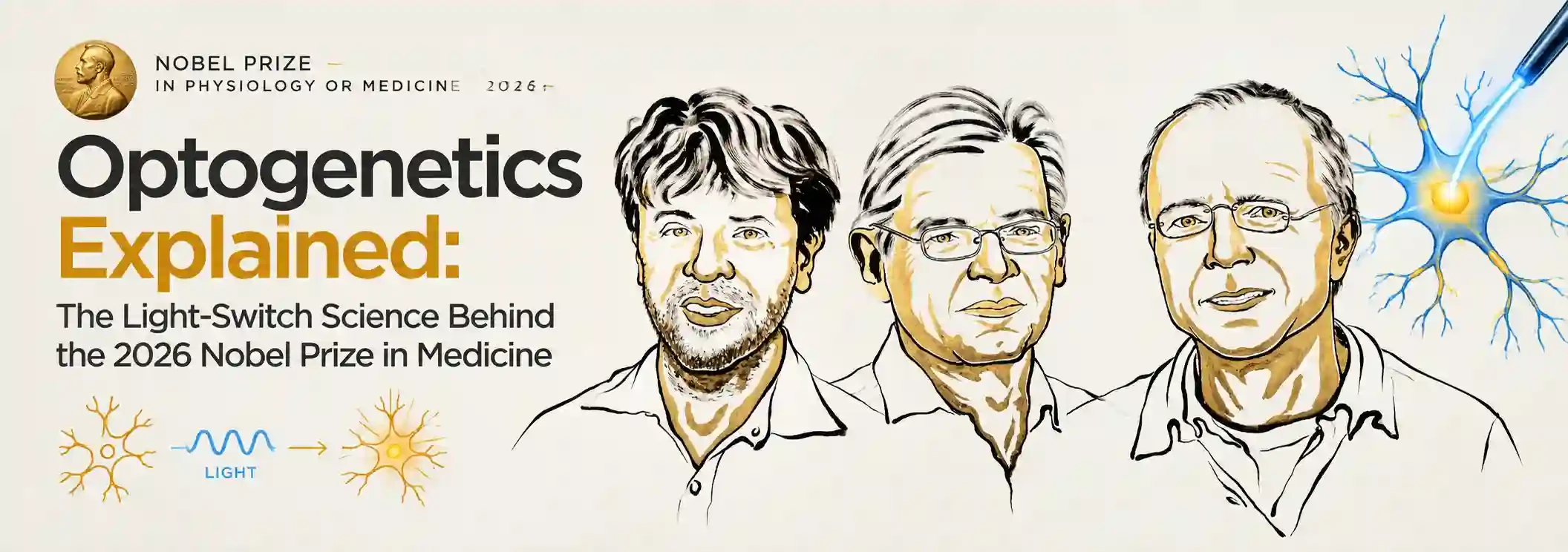
Optogenetics is a research technique that combines genetics and light to influence the activity of selected cells. In neuroscience, scientists can introduce genes for light-sensitive proteins into particular neurons and then use carefully controlled light to change those cells' electrical activity. This gives researchers a way to test how specific groups of neurons contribute to a circuit, behaviour or biological process.
The 2026 Nobel Prize in Physiology or Medicine recognised Karl Deisseroth, Peter Hegemann and Georg Nagel for discoveries concerning light-gated ion channels and optogenetics. The award recognised foundational work that made it possible to control selected nerve cells with light; it did not mean that optogenetics is already a routine cure for brain disorders.
Neurons communicate partly through electrical changes across their cell membranes. Certain proteins respond to light by allowing charged particles to cross a membrane. Channelrhodopsins, first studied in light-sensitive microorganisms, are important examples of these light-gated ion channels.
In a typical experimental setup, researchers use genetic methods to make a chosen cell population express a light-sensitive protein. A light source then activates the protein, changing the cell's electrical state. Depending on the protein and experimental design, light can make a neuron more likely to fire or can inhibit activity. Researchers record the response and compare it with control conditions.
The method's value is precision: investigators can manipulate a defined cell population at a chosen time, then test whether that manipulation changes activity elsewhere in a neural circuit. It is still a sophisticated laboratory procedure, not a simple light treatment that can be applied to any brain.
Peter Hegemann and Georg Nagel helped establish the properties of channelrhodopsins in microorganisms. Karl Deisseroth and other researchers helped translate light-sensitive proteins into tools for controlling neurons in living systems. These steps connected basic biology—how organisms respond to light—with experimental neuroscience.
Before optogenetics, researchers had ways to observe brain activity and methods to stimulate tissue, but selectively testing the role of a particular cell type at precise moments could be difficult. Optogenetics added a powerful experimental approach for investigating cause and effect in neural circuits.
Researchers can test how specific neurons contribute to movement, sensory processing, learning or behaviour in model organisms. Such experiments help evaluate a causal role for a circuit, although results in animals do not automatically translate to people.
Optogenetics is used in research related to conditions such as epilepsy, Parkinson's disease, depression and other neurological or psychiatric disorders. It can help scientists investigate circuit mechanisms and potential treatment targets. This is not the same as proving that a clinically effective optogenetic therapy exists for each condition.
Scientists are exploring whether light-sensitive proteins could help restore certain functions in cells that no longer respond normally. Some approaches have entered early clinical investigation, but each has its own safety, delivery, device and efficacy questions. The evidence must be assessed trial by trial.
Optogenetics commonly requires genetic delivery of a light-sensitive protein and a way to deliver light to the target tissue. In deep brain structures, light delivery can be invasive; gene delivery adds its own biological and regulatory challenges. Researchers also have to check whether a protein changes normal cell function, whether the effect lasts, and whether the intervention affects unintended cells.
Clinical use would require evidence of meaningful benefit, reliable delivery, appropriate controls, long-term safety and a clear comparison with existing treatments. It is inaccurate to describe optogenetics as a proven general treatment for memory loss, Alzheimer's disease or mental illness.
These methods can complement one another; no single technique answers every neuroscience question.
Karl Deisseroth, Peter Hegemann and Georg Nagel were recognised for discoveries concerning light-gated ion channels and optogenetics.
Not generally. Research setups need light to reach the relevant cells, often using specialised optical equipment. Delivery methods depend on the tissue and experiment.
No. It is an established research technique, while proposed clinical applications remain at different stages of investigation and require separate evidence.
Researchers can study neural circuits involved in learning and memory, particularly in model systems. That does not mean scientists can precisely edit or control human memories as a routine clinical procedure.
Optogenetics is a major advance because it lets researchers use light-sensitive proteins to test how selected cells contribute to neural activity. The 2026 Nobel Prize recognised the foundational discoveries behind this approach. Its scientific impact is substantial, but possible treatments should be judged by the quality and stage of clinical evidence—not by the promise of the technique alone.
This article was authored and reviewed by Wipidia's technical editorial desk in Jalandhar, Punjab. Every code snippet, algorithm breakdown, and strategic framework is independently tested against live production standards before publication.